


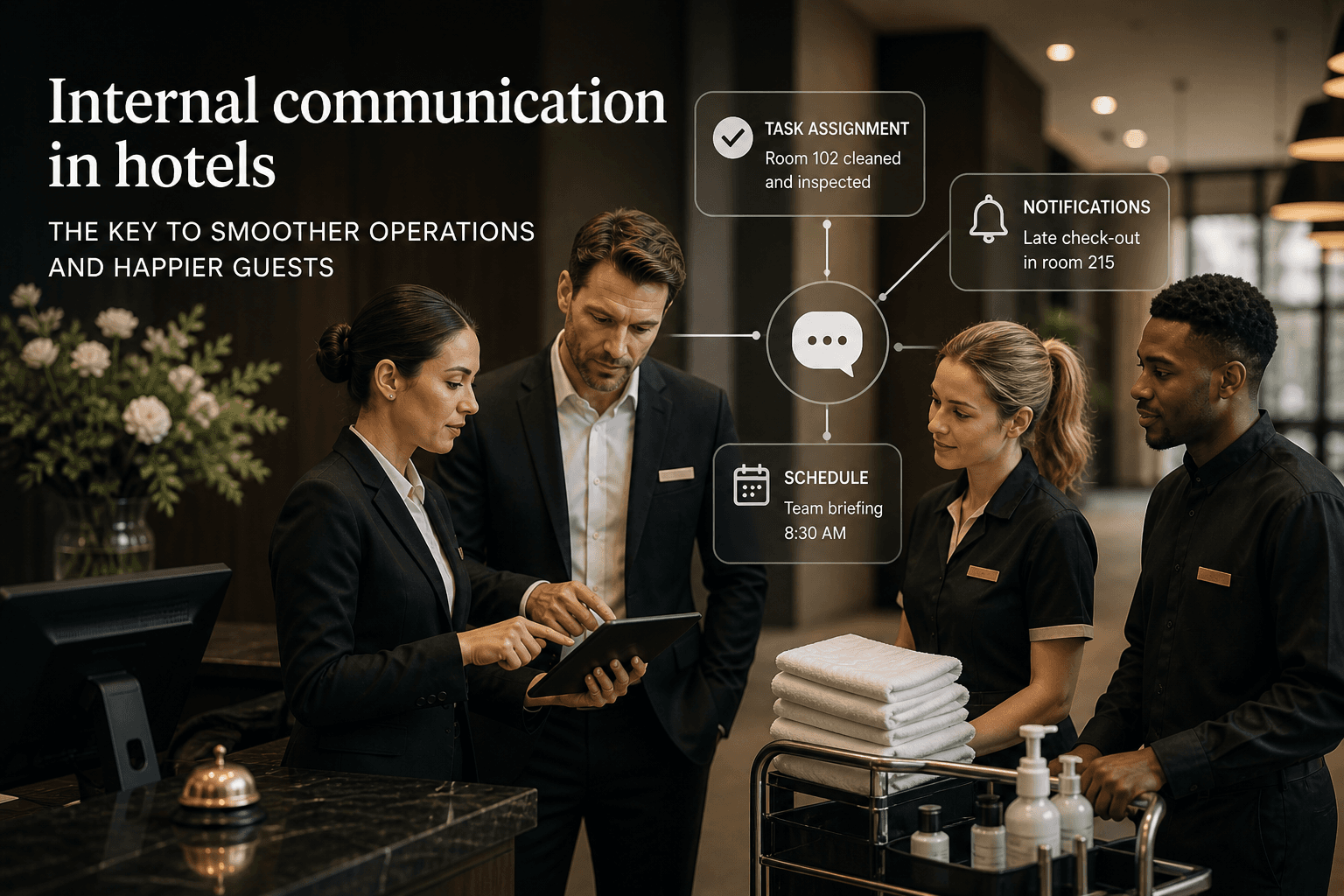
Internal communication in hotels — why it often doesn’t work
Internal communication is one of those things everyone knows is important in hotels. And yet, it’s often where things break.
It doesn’t always show up immediately. But you feel it in everyday operations: a room that isn’t ready on time, a detail that gets missed, someone who never got the right information. And almost always, you can trace it back to the same thing.
Communication didn’t work the way it should have.
It’s not a lack of will
Most people working in hotels know exactly what needs to be done. The problem isn’t knowledge.
It’s making everything work when the pace is high and a lot happens at once.
Information has to move from one person to another. Shifts hand over. Priorities change quickly. It only takes one small thing not getting through — and the next step is affected immediately.
Information exists — but not where it’s needed
In many hotels, the information already exists. But it’s scattered.
Some things are said in passing. Some are written in a message. Some live on a whiteboard.
For the person working in the moment, it becomes hard to know what actually applies. The result is that people:
- work from outdated information
- miss updates
- or have to ask again
That takes time. And it creates unnecessary interruptions.
Small misses that become big outcomes
It’s rarely the big things that go wrong. It’s the small ones.
A task that wasn’t done. A change that didn’t reach the right person. Someone who assumed someone else owned it.
On their own, they don’t seem like a big deal. But together, they affect quality. And eventually, guests notice.
“I thought someone else had it”
This is more common than you think.
When communication isn’t clear, ownership becomes unclear too. Who does what? Is it done? Is anyone following up?
Without clarity, it’s easy for things to fall between the cracks — not because people don’t care, but because it isn’t clear enough in the moment.
The time lost to questions
A large part of the day often goes to small questions:
- “Has this been done?”
- “Do you know what applies here?”
- “Who was supposed to take this?”
Each question might only take a minute. But it breaks focus. And across a day, it adds up.
When communication works, you notice immediately
The interesting thing is: you almost never talk about communication when it works. Things just flow.
People know what to do. Work gets done in the right order. No one has to chase answers.
It’s only when it doesn’t work that you feel it.
What makes the difference in practice?
It’s rarely about communicating more. It’s about making communication clearer.
In practice, it usually comes down to three things:
- Information is gathered in one place
- It’s tied to what actually needs to be done
- It’s easy to understand in the moment
When those three are in place, everyday work changes quickly.
What it looks like when it works in real life
There are hotels that have gotten this right — not by working harder, but by making it easier to do the right thing.
A concrete example is how Nobis runs daily operations, where communication is clearer and workflows are established in a completely different way.
👉 Read how Nobis makes operations work in practice
It almost always starts here
Most operational problems look different on the surface. But when you strip things down, you often land on the same root cause.
Communication.
If you get it right, a lot becomes easier. And this is where many of the biggest improvements actually begin.