

Many organisations invest heavily in reducing technical debt. They clean up codebases. They replace systems. They invest in structure.
And yet the same pattern repeats: work still doesn’t flow.
It’s not the systems that are the problem
Tasks get missed. Things are done differently every time. People have to ask what the rule is.
Even when systems are in place and processes are documented, the same issues show up in daily work. That suggests the challenge is not technology itself, but how work is actually organised and executed.
What is technical debt?
Technical debt is a well-known concept in software development. It describes the trade-offs made in code and systems to ship faster. Over time, those trade-offs increase the cost of maintenance, complexity, and future change.
But this is something else
In many organisations, problems cannot be tied to technical limitations.
Work doesn’t live in the systems. It lives in:
- text messages
- verbal instructions
- ad hoc fixes
- individual habits
That is where inefficiency starts to compound.
What is operational debt?
Operational debt is the accumulation of inefficient ways of working, unclear processes, and manual workarounds that grow over time. Unlike technical debt, it doesn’t only slow down development; it affects the whole organisation’s ability to execute well every day.
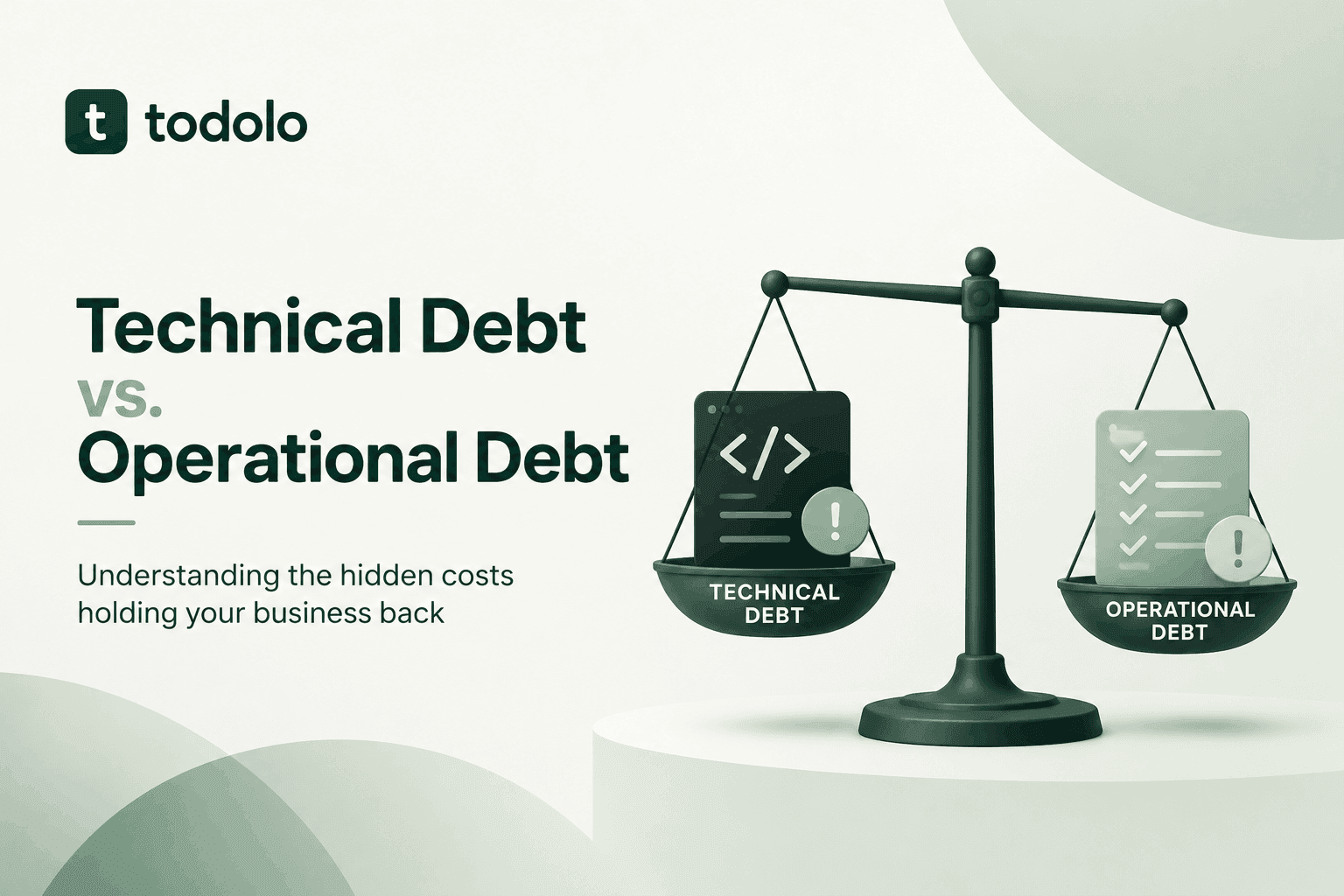
Technical debt vs operational debt
| Dimension | Technical debt | Operational debt |
|---|---|---|
| What it affects | How fast systems can be built and changed. | How well work is actually performed day to day. |
| Effect | Slows change in code and platforms. | Slows everyday execution, every day. |
One is about the foundation. The other is about how people work when the door closes behind them.
Common signs of operational debt
- Tasks are missed or not followed up
- Processes exist but are not used consistently
- People keep asking what the rule is
- Ways of working differ between teams or locations
If several of these sound familiar, structure and follow-up probably need to sit closer to daily work, not only closer to IT.
How to start reducing operational debt
Reducing operational debt is not mainly about more documents or more tools by themselves. It is about clarity in how work is done. Processes need to become part of the working day, not a parallel world.
With a platform like Todolo, routines, tasks, and follow-up can live in one place so work is not only described; it can be executed and verified afterwards. That improves both engagement and the link between strategy and the front line.
👉 Want to go deeper? Read more about operational debt and how to address it systematically.
Contact us if you would like to discuss how your team can get better flow between instruction and action.