


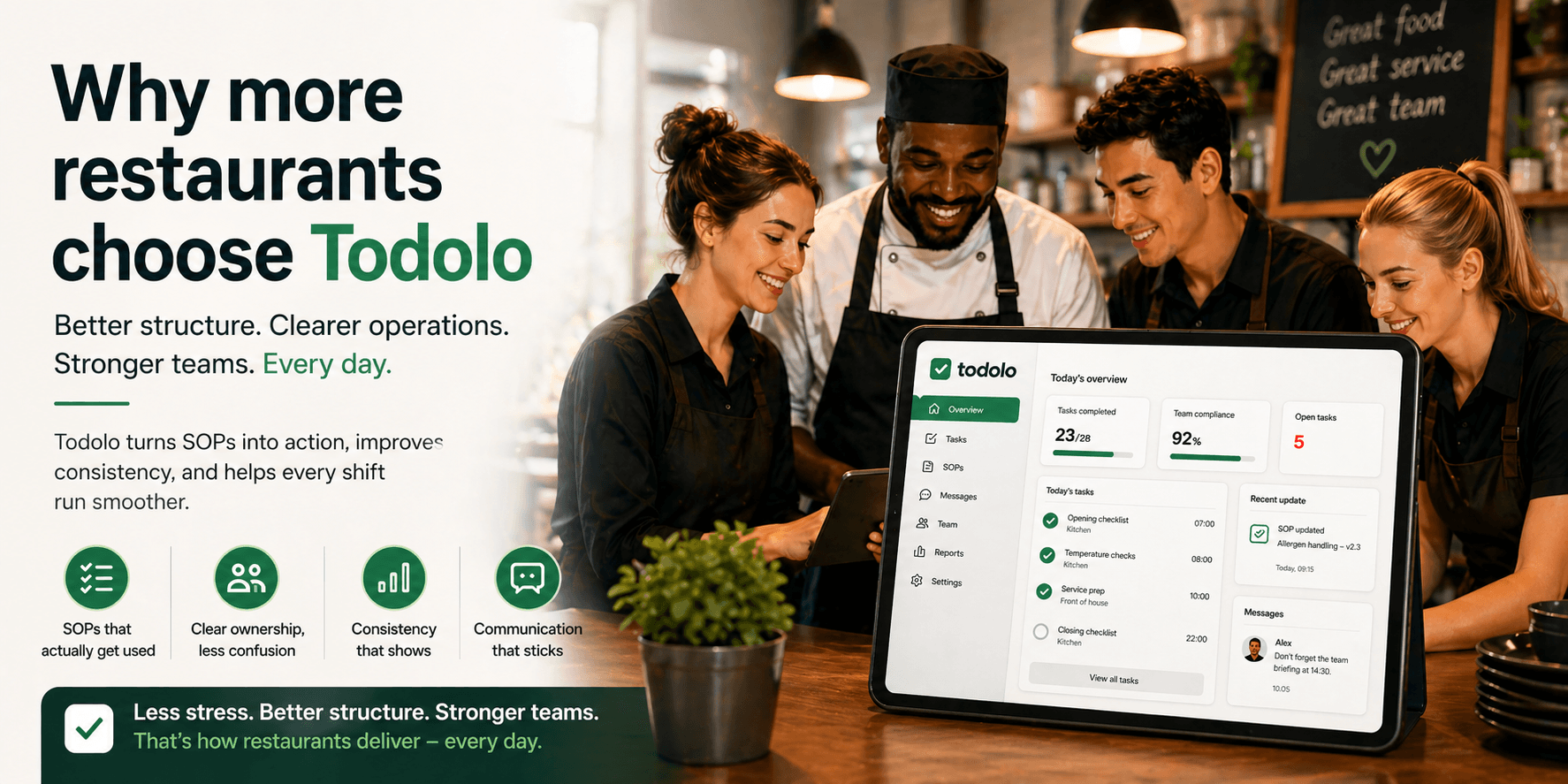
Why more restaurants are switching to Todolo
It’s rarely a big strategic decision.
It usually starts in the day to day.
A schedule that doesn’t reach everyone.
A checklist that gets forgotten.
A new hire who has to “shadow” for a bit too long.
Small things that add up to a bigger problem.
And eventually you realize it’s not about isolated mistakes. It’s about how the restaurant actually runs every day.
That’s when many teams start looking at Todolo.
When operations start costing more than they should
Most restaurants we talk to don’t have a tech problem.
They have a structural problem in the day to day:
- People do things differently depending on who’s on shift
- Routines exist, but aren’t followed consistently
- Managers spend time reminding instead of improving
- The guest experience becomes uneven
And you feel it immediately, in both margins and reviews.
That’s often when the thought appears:
“There has to be an easier way to work.”
Why SOPs aren’t enough (as they are today)
Many restaurants already have SOPs.
The problem isn’t that they don’t exist. The problem is they’re not used in practice.
If you want an SOP for restaurant operations that actually gets used, start here: what an SOP is and how to write one (with template).
They live in:
- Google Docs
- binders
- old onboarding documents
- or an app that’s hard to navigate and that nobody really uses
And in a busy service, nobody has time to search.
If it takes too long to find the right thing, or it feels unclear what applies, people fall back on:
“how we usually do it”
That’s where inconsistency starts.
What changes when restaurants switch to Todolo
When restaurants move to Todolo, it’s not about introducing “a new system”.
It’s about changing how work actually happens.
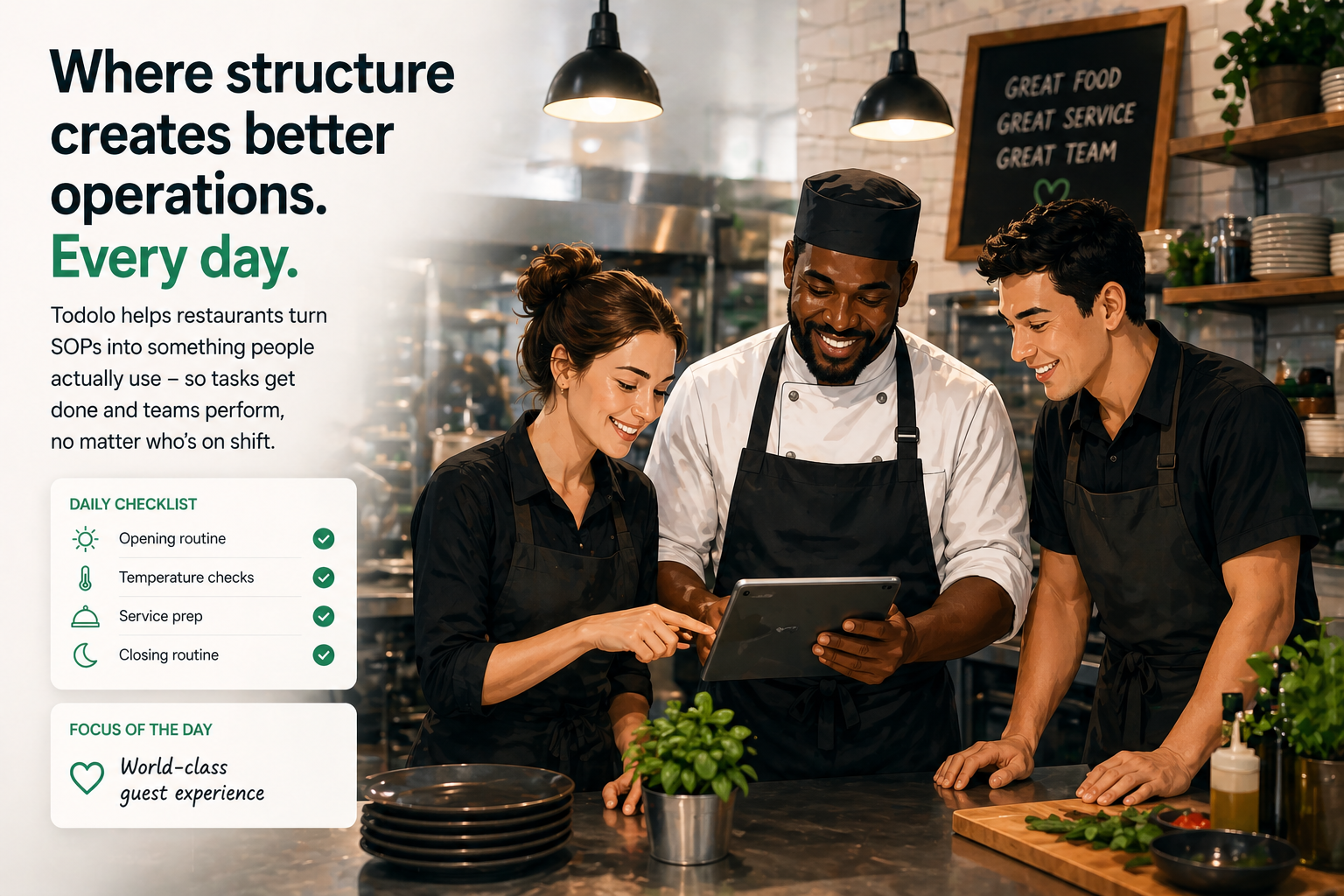
Instead of:
- chasing tasks
- repeating instructions
- solving the same problems every week
you build an operating rhythm where the structure is already there.
In practice, that means:
- Checklists that recur automatically (daily, weekly, monthly)
- Clear ownership, who does what and when
- SOPs connected directly to daily work
- Follow up that happens continuously, not after the fact
- Onboarding you can actually rely on
This gets even more effective when you connect it to workflow automation. Read: workflow automation that actually works day to day.
Less reactive. More predictable.
Four reasons more restaurants are switching
We see the same patterns again and again:
1. They’ve outgrown their old way of working
What worked with a smaller team doesn’t hold up anymore.
2. They want less dependency on individuals
Knowledge shouldn’t live in one person’s head.
3. They want higher quality, without more stress
Structure instead of more control.
4. They want SOPs to actually get used
Not just exist.
Why Todolo works in a restaurant environment
Many tools are built for office teams.
Restaurants need something different:
- Something that works on mobile
- Something that’s fast to understand
- Something that doesn’t require training to use
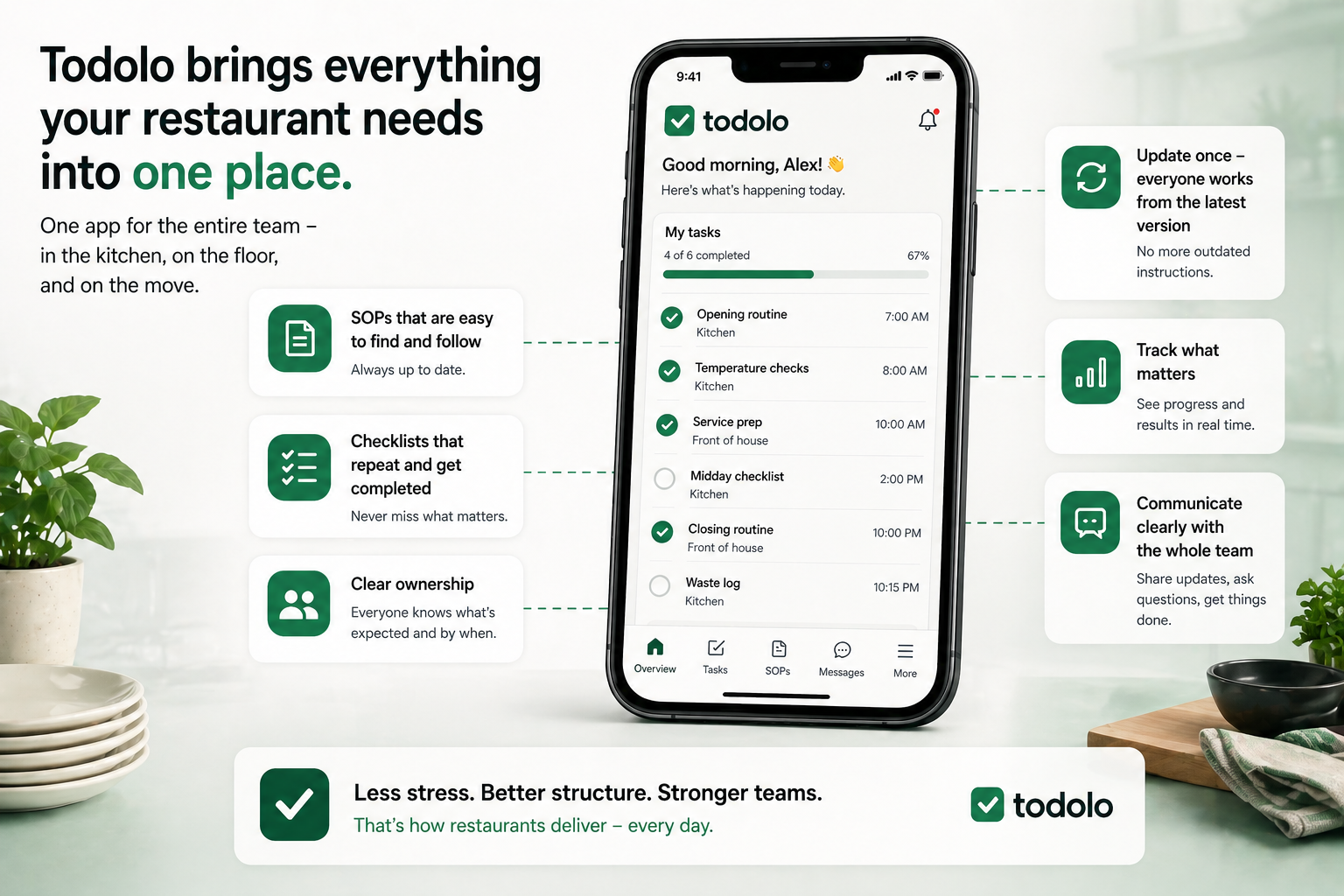
If you’re evaluating a staff app for restaurants, here’s a practical guide: mobile app for deskless workers.
Todolo is built for operations.
For teams working at pace, where clarity beats complexity every time.
Want to see how to structure restaurant operations in practice? Explore the Operations module.
The result: less friction in the day to day
What we most often hear after restaurants get going:
“We don’t have to chase people anymore.”
“Everyone does it the same way now.”
“It’s much easier to onboard new staff.”
“We have better control, without spending more time.”
They’re not huge changes on their own. But together they make a real difference.
Want to see what it could look like for you?
If this feels familiar, you’re not alone.
We’re happy to show you how other restaurants run Todolo, and what it could look like in your day to day.
👉 Book a 20-minute walkthrough
So you have something concrete to decide on.