

HACCP Implementation: A Practical Guide for Food Businesses
A clear HACCP plan doesn’t have to mean piles of paperwork. This guide walks you through what HACCP is, how to implement it, and how to keep it manageable—whether you run a kitchen, a factory, or a retail site.
What is HACCP?
HACCP (Hazard Analysis Critical Control Points) is a structured way to manage food safety by finding and controlling risks before they reach the consumer. Instead of relying only on testing the finished product, you identify where things can go wrong in your process and put controls at those points.
It started in the 1960s when Pillsbury, NASA, and the U.S. Army needed safe food for space missions. Today it’s the global reference for food safety, and in many countries it’s required by law. In Sweden, Livsmedelsverket applies EU rules that expect HACCP-based procedures from most food businesses.
Getting HACCP right helps you stay on the right side of the authorities, avoid recalls, and give customers confidence. It also tends to cut waste and rework because you catch problems early.
The 7 HACCP Principles (In Plain Terms)
HACCP is built around seven steps. Here’s what they mean in practice.
1. Hazard analysis
List everything that could go wrong at each step of your process: biological (e.g. bacteria, viruses), chemical (cleaning agents, allergens), and physical (e.g. metal, plastic). Then decide which of these are realistic and serious enough that you must control them.
2. Critical Control Points (CCPs)
A CCP is a step where you can apply a control that is necessary to remove or reduce a food safety hazard. Not every step is a CCP—only those where control is essential. Decision trees help you decide which steps qualify.
3. Critical limits
For each CCP, set clear, measurable limits (e.g. minimum cooking temperature, max cooling time, pH). If you’re outside these limits, the product is not safe to use. Limits should be based on science or regulation, not guesswork.
4. Monitoring
Define what you will measure, how often, how you’ll do it, and who’s responsible. Monitoring has to be often enough to spot a problem before unsafe food leaves your site.
5. Corrective actions
Plan in advance what you’ll do when a limit is breached: what happens to the product (hold, rework, discard), how you fix the cause, and how you record it. If you only decide in the moment, you’ll forget steps and struggle in an audit.
6. Verification
Check that your HACCP system actually works: validate the plan, calibrate equipment, review records, and do internal audits. Verification is what turns a paper plan into something you can trust.
7. Documentation and records
Keep records of your plan, hazard analysis, CCPs, limits, monitoring, corrective actions, and training. Regulators and auditors will ask for them. Good documentation also helps you trace issues and improve over time.
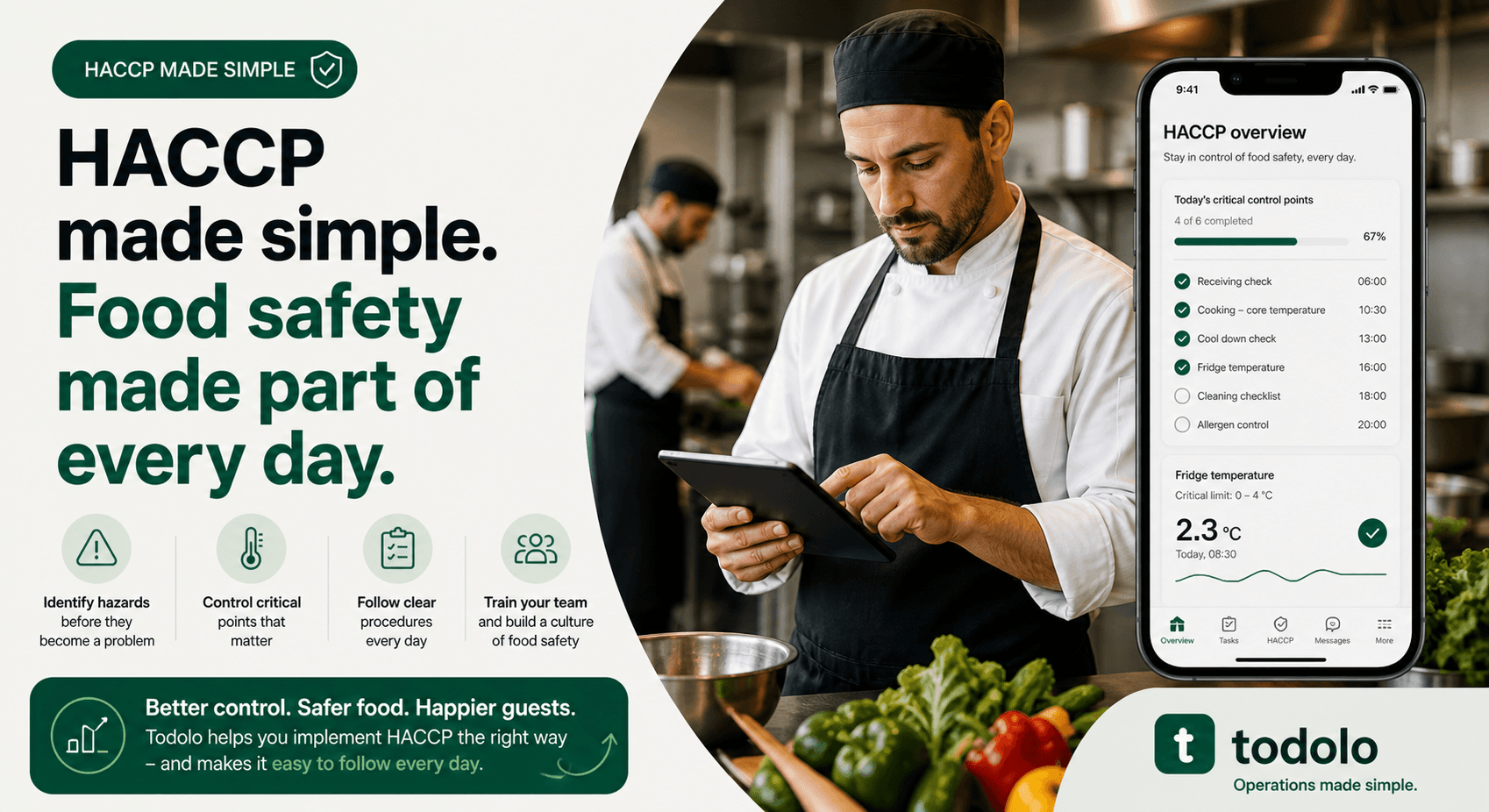
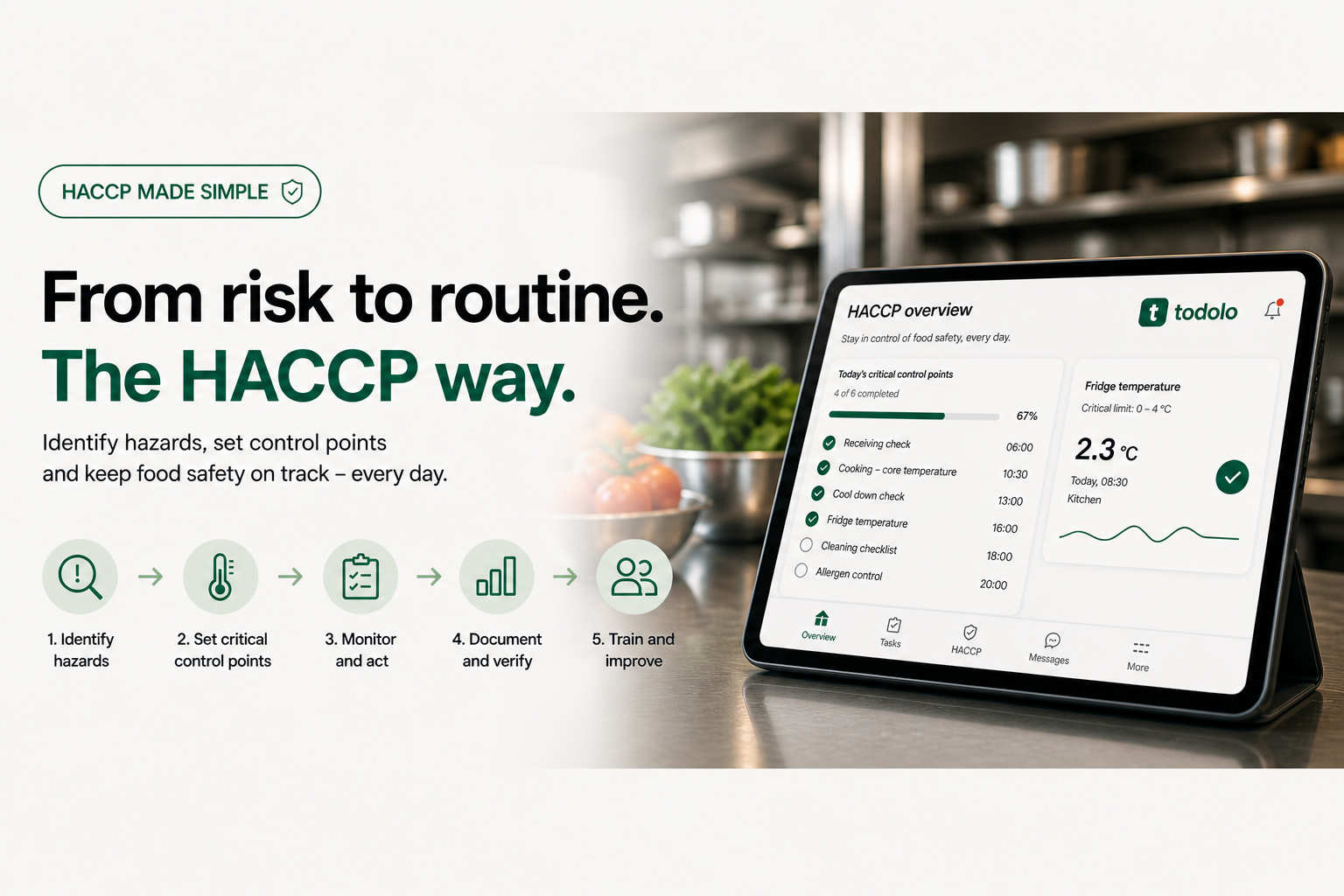
How digital tools fit in: Platforms like Todolo can centralise hazard analysis, CCP checklists, and monitoring so nothing is missed. Alerts when limits are exceeded, automatic record-keeping, and one place for all HACCP documents make it easier to stay compliant without drowning in paper.
Quick examples
- Hazard analysis: In a kitchen, you might list cross-contamination from raw poultry, allergens from shared equipment, and metal from worn utensils. You then decide which of these you’ll control and how.
- CCP: Cooking poultry to a minimum core temperature is a classic CCP; without it, pathogens can survive. Receiving chilled goods and storing them within time limits can be CCPs too.
- Critical limits: For cooked poultry, a common limit is “core temperature ≥75°C (or equivalent time/temperature).” For cooling, “below 8°C within 90 minutes” might be your limit. Your authority or standard gives the exact numbers.
- Corrective action: If a chill cabinet drifts above 5°C, your plan might say: move product to a working unit or discard if uncertain, fix the cabinet, log the event, and check that it doesn’t happen again.
What Your HACCP Plan Should Include
Your written HACCP plan typically needs: a product description (ingredients, process, storage, shelf life, intended use), a process flow diagram from raw materials to finished product, a hazard analysis, how you identified CCPs, and a plan table with each CCP, its limits, monitoring, corrective actions, and verification. Add supporting docs (e.g. prerequisite programmes, training, calibration). Templates help, but the plan must be tailored to your products and processes. If you copy a generic plan without adapting it, auditors and authorities will notice—and the real risks in your operation might not be covered.
How to Implement HACCP: A Checklist
Before you start: Put together a small team (production, quality, and at least one person with HACCP training). Be clear which products and processes the plan covers. Make sure basics like GMP and cleaning are in place—HACCP builds on these.
Building the plan: Describe each product and its intended use. Draw the process flow and walk the floor to confirm it’s accurate. Do the hazard analysis, identify CCPs, set critical limits, and define monitoring and corrective actions. Set up verification (e.g. internal audits, record reviews) and a simple system for keeping records.
After launch: Train everyone on their role. Run monitoring as planned, review records regularly, and update the plan when processes, products, or regulations change.
Keep the plan as a living document: when you change a recipe, add a line, or get new equipment, the hazard analysis and CCPs may need a tweak. An annual review is a minimum; many teams do a quick check every quarter. Digital checklists and task reminders help teams stick to monitoring and documentation without relying on paper.
Common HACCP Challenges (And What Works)
Training gaps
If people don’t understand why a step matters, they’ll skip it or fill forms without thinking. Invest in role-specific training and keep records. Refreshers and short updates when something changes go a long way.
Inconsistent monitoring
Missed checks or scribbled numbers on paper are a classic audit finding. Digital checklists with reminders and timestamps make it easier to do the right thing every time and prove it.
Too much paperwork
Paper-based HACCP often becomes unmanageable. Moving to a single digital system for plans, checklists, and records cuts clutter and makes it easier to find what you need for an audit.
HACCP vs. ISO 22000
HACCP is the core method: seven principles to identify and control food safety hazards. It’s often a legal requirement. ISO 22000 is a wider food safety management system standard: it includes HACCP plus things like leadership, planning, and continuous improvement. Many companies get HACCP in place first, then move toward ISO 22000 if they want a certified management system.
HACCP in Restaurants, Manufacturing, and Retail
The same seven principles apply everywhere, but how you apply them changes. Restaurants often focus on receiving and storage temps, cooking and holding temperatures, cross-contamination, and allergen control; staff need simple checklists they can complete during service. Manufacturers usually have more process steps, equipment validation, and batch traceability, so the HACCP plan and documentation are heavier. Retail centres on cold chain, display temperatures, and date management. In all cases, the aim is the same: know where the risks are, control them at critical steps, and keep records that show you did it.
Legal Requirements for HACCP
In the EU, Regulation (EC) No 852/2004 requires food businesses (except primary producers) to use procedures based on HACCP principles. Livsmedelsverket enforces this in Sweden and publishes guidance. You need a written plan, monitoring and corrective action records, verification evidence, and training records. Keeping everything in one digital place makes it easier to show compliance when authorities or auditors ask.
Staying on top of compliance: Subscribe to updates from Livsmedelsverket (and any sector bodies you use). When regulations or guidance change, schedule a quick review of your plan and update it if needed. Internal audits once or twice a year help you find gaps before an official inspection.
HACCP Training: Who Needs What?
At least one person on the HACCP team should have formal HACCP training. Staff who monitor CCPs need to know the limits and what to do when they’re exceeded. Everyone else needs basic food safety awareness. Document who was trained and when; regulators will ask.
FAQ
What is HACCP?
HACCP is a systematic way to identify, evaluate, and control food safety hazards through the production process. It’s preventive: you control risks at critical steps instead of only testing the final product.
How do I implement HACCP?
Assemble a team, describe your products and process, do a hazard analysis, identify CCPs, set critical limits, define monitoring and corrective actions, and set up verification and documentation. Use a template if you like, but customise it to your site. Digital tools can guide you and keep records in one place.
What are the legal requirements for HACCP?
In the EU and Sweden, food businesses (except primary producers) must have procedures based on HACCP principles. You must keep a written plan and records and make them available to authorities. Livsmedelsverket’s website has the details.
What’s the difference between HACCP and ISO 22000?
HACCP is the hazard-control methodology (the seven principles). ISO 22000 is a full management system standard that includes HACCP plus requirements for how you run and improve the system. HACCP is often mandatory; ISO 22000 is usually voluntary certification.
How often should I review my HACCP plan?
At least once a year, and whenever your process, equipment, or products change, or when corrective actions show a recurring problem.
Can I use HACCP templates?
Yes. A template gives you a structure and reminds you of the sections you need. But you must customise it: your hazards, CCPs, and limits depend on your products and site. A template that still says “insert your process here” at audit time is a red flag.
What if I find a deviation at a CCP?
Follow your predetermined corrective action: stop if needed, isolate affected product, correct the cause, document everything, and verify that the fix worked. A digital incident workflow can prompt the right steps and keep the audit trail.
How do I implement HACCP in a multi-site business?
Use one common approach (same principles, same type of plan) but each site should have its own hazard analysis and CCPs if processes differ. A central digital system helps: shared templates, consistent monitoring and reporting, and one place for records so head office and auditors can see every site.
Wrapping Up
HACCP is a living system. Implement it properly, review it regularly, and keep records so you can prove you’re in control. When documentation and monitoring run on a single platform, daily compliance gets simpler and audits become less stressful.
Want to simplify HACCP documentation and monitoring? Todolo helps food businesses manage hazard analysis, CCP checklists, corrective actions, and training in one place. Contact Todolo about HACCP compliance and documentation support or explore our operations module for task management and checklists.