

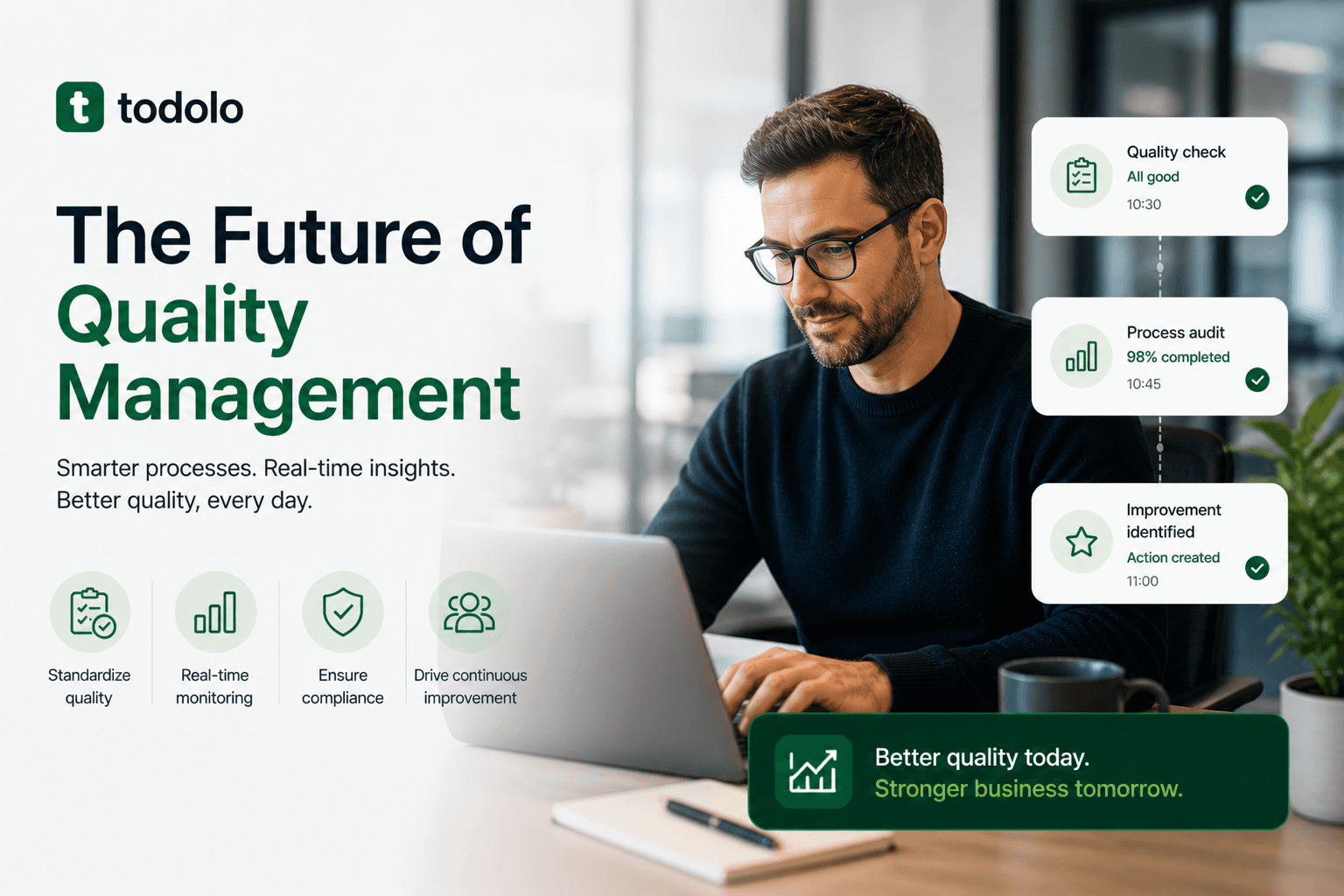
AI and Automation in Quality Management: Benefits, Use Cases, and Getting Started
AI and automation are changing how teams run quality management—from reacting to defects to predicting and preventing issues earlier in the process. That shift matters now because customers, auditors, and regulators expect traceable data, consistent checks, and faster corrective action.
In this guide, you’ll learn how AI is applied in quality management, what automation usually improves first, and practical steps to get started without a multi-year IT project.
Why AI and Automation Are Reshaping Quality Management
Quality management is undergoing a profound transformation as artificial intelligence and automation technologies reshape traditional approaches to excellence. Organizations across industries are witnessing a fundamental shift from reactive quality control methods to proactive, predictive systems that anticipate issues before they occur. This evolution represents not just an incremental improvement but a complete reimagining of how quality is defined, measured, and achieved.
The integration of these advanced technologies is enabling quality professionals to move beyond simple inspection and control to comprehensive quality prediction and prevention. As digital transformation accelerates across industries, the convergence of AI, machine learning, advanced analytics, and automated systems is creating new quality paradigms that combine unprecedented precision with remarkable efficiency.
For quality leaders navigating this rapidly changing landscape, understanding these technologies and their practical applications has become essential for maintaining competitive advantage. The organizations that successfully integrate these innovations while preserving core quality principles will set new standards for operational excellence in the coming decade.
How to Implement AI in Quality Management
A phased approach usually beats a big-bang rollout. Use this sequence as a practical checklist:
-
Identify repetitive processes — Look for inspections, data entry, approvals, and reporting that follow the same pattern every week. These are often the best first candidates for automation.
-
Collect and structure data — AI and analytics only help when measurements, deviations, and actions live in consistent formats—not only spreadsheets or email. Connect checklists, sensors, and production data where you can.
-
Start with automation tools — Automate workflows, alerts, and documentation before you invest in complex models. Shorter cycle times and fewer manual errors often deliver value immediately.
-
Introduce predictive analytics — Once data is reliable, pilot prediction on one line or one product family: likely failures, bottlenecks, or recurring deviation types.
-
Scale gradually — Expand to additional sites, suppliers, or product lines after you’ve validated governance, training, and metrics from the pilot.
Key Use Cases of AI in Quality Management
Artificial intelligence has become a practical tool in quality control—especially where humans struggle with speed, consistency, or large data volumes.
Common AI use cases in quality management include:
- Automated inspection (e.g., visual checks at scale with computer vision)
- Defect detection that flags subtle patterns and anomalies
- Quality prediction that forecasts issues before production ramps up
- Process optimization that continuously tunes parameters for stable output
- Risk assessment across suppliers, sites, and complex workflows
What teams typically get from these applications:
- Higher inspection accuracy and fewer defects escaping downstream
- Faster throughput (often enabling 100% checks without slowing production)
- Less human variability in inspections and decision-making
- 24/7 monitoring without fatigue
- Earlier warnings so quality moves from reactive to preventive
Quality management platforms like Todolo are increasingly incorporating AI capabilities to enhance inspection processes, automate routine quality tasks, and provide predictive analytics that identify potential issues before they impact production. By integrating these AI tools with traditional quality management processes, organizations can achieve previously impossible levels of quality assurance while reducing costs and resource requirements.
Automated Quality Systems: Inspection and Consistency at Scale
Automated quality systems go beyond manual inspection by combining consistent measurement with reliable documentation.
Typical components include:
- Robotic inspection stations for repeatable, objective evaluation
- Automated testing equipment for complex assessments with less manual work
- Digital measurement tools capturing dimensional data in real time
- Process control systems that keep conditions within target ranges
- Data collection frameworks that capture quality signals across operations
A simple implementation sequence:
- Select the right system for the specific quality requirement
- Integrate with workflows (so it’s used, not bypassed)
- Calibrate measurements and thresholds
- Validate performance against known standards
- Monitor reliability and drift over time
These automated systems deliver transformative benefits including unprecedented consistency in quality evaluation, substantial cost savings through reduced labor requirements, significantly faster quality assessments that support higher production speeds, comprehensive documentation that enhances traceability, and improved resource utilization that optimizes quality investments.
Data-Driven Quality Management: Analytics for Better Decisions
Quality management is increasingly data-driven. The key is collecting reliable signals from the places where quality is created and verified.
Common data sources include:
- Sensors and IoT embedded in production processes
- Production metrics tracking performance across key variables
- Measurements at control points (critical checks and sampling)
- Customer feedback that captures perceived quality
- Historical datasets that add context for trends and seasonality
With the right data, teams can run:
- Real-time monitoring for immediate visibility
- Trend analysis to spot patterns early
- Predictive models that forecast outcomes and risks
- Performance metrics across sites/lines/teams
- Quality scoring for objective comparison
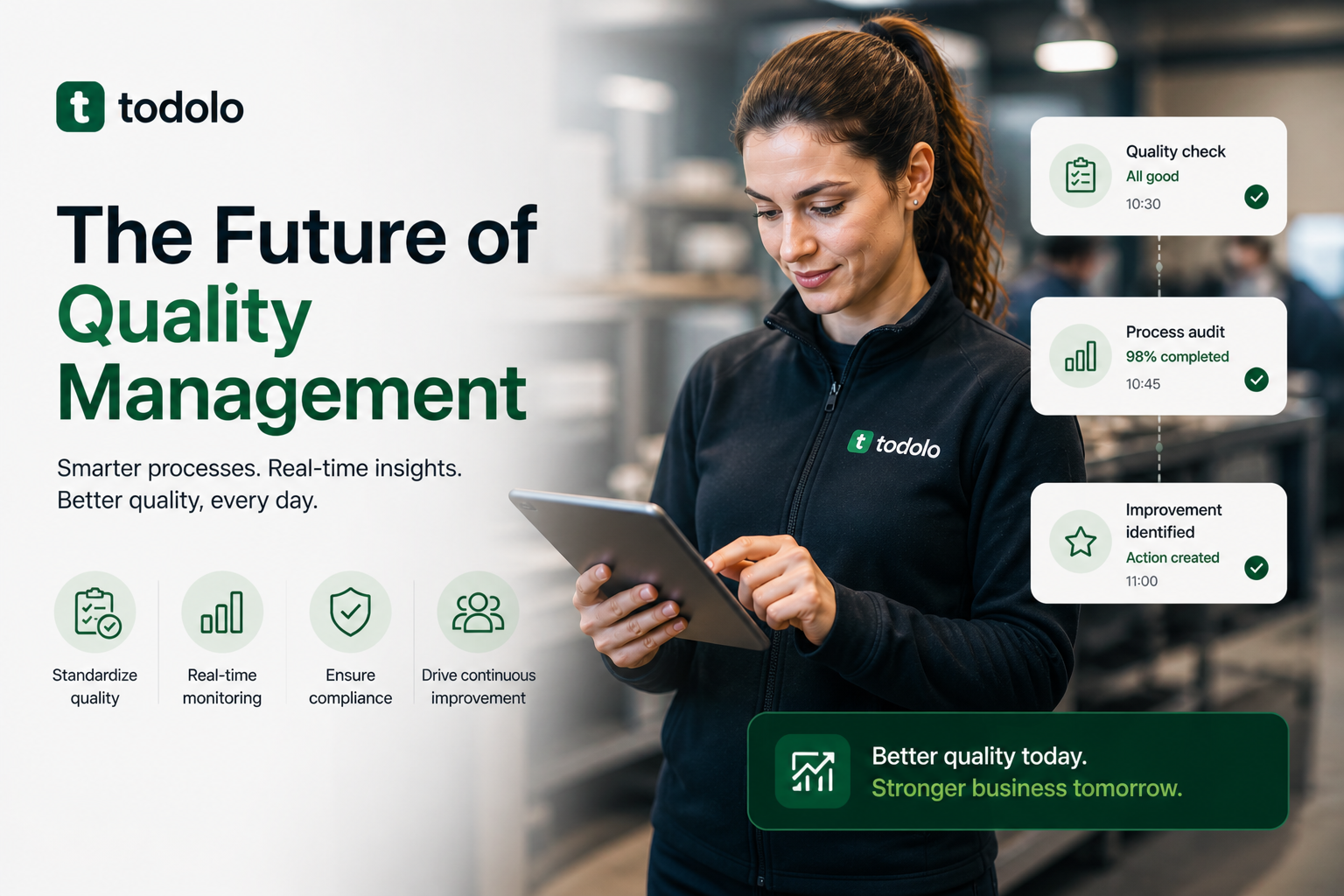
Quality management platforms like Todolo facilitate this data-driven approach by providing robust data collection tools, sophisticated analytics capabilities, and intuitive visualization features that transform complex quality information into actionable insights. This integration of data collection, analysis, and visualization creates a continuous improvement ecosystem where quality decisions are based on objective evidence rather than subjective assessment.
Smart Quality Tools and Connected Technologies
Modern quality teams use connected tools to reduce manual work and increase consistency.
Examples include:
- AI-powered camera systems detecting subtle visual defects
- Automated gauges producing consistent measurements
- Digital calipers/measurement tools that record and transmit data automatically
- Smart sensors tracking environmental and process conditions
- Quality software platforms coordinating documentation and follow-up
What these tools typically enable:
- Real-time analysis while the work happens
- Automated reporting to reduce documentation overhead
- Alerts and escalations routed to the right owner
- Dashboards/visualization that make the data usable
- Integrations with broader operational systems
For quality professionals, these smart tools represent a dramatic enhancement in capabilities, enabling more comprehensive quality monitoring with fewer resources. The combination of enhanced precision, automated data collection, and real-time analysis creates quality systems that are simultaneously more thorough and more efficient than traditional approaches.
Process Automation for Quality Workflows
Automation removes friction from quality workflows—especially the repetitive parts.
Common workflows to automate:
- Routine inspections and scheduled checks
- Data collection across sites/lines/teams
- Report generation and audit-ready documentation
- Alerts and escalation when thresholds are exceeded
- Corrective actions (CAPA) with clear owners and follow-up
Benefits you usually see first:
- Higher efficiency and lower admin time
- Reduced labor cost for repetitive work
- More consistent execution across shifts and sites
- Faster response when issues appear
- Better focus for specialists on prevention and improvement
Platforms like Todolo support this automation journey by providing integrated tools that streamline quality workflows, automate routine tasks, and ensure consistent implementation of quality procedures. By reducing the administrative burden associated with quality management, these platforms allow organizations to implement more thorough quality systems without corresponding increases in overhead costs.
Quality Standards and Digital Frameworks
Standards are evolving to include digital quality and traceable execution.
Modern frameworks often include:
- ISO 9001:2015 (risk-based thinking)
- Industry 4.0 principles for connected production
- Digital quality frameworks (data integrity, validation, audit trails)
- Smart manufacturing standards for connected environments
- Sustainable quality approaches balancing excellence with ESG expectations
Implementing these evolved standards follows a structured methodology beginning with careful standard selection based on organizational needs, thorough gap analysis that identifies improvement opportunities, detailed process mapping that aligns operations with standard requirements, comprehensive system integration that connects quality tools with standards frameworks, and formal certification processes that validate compliance and excellence.
As these standards continue to evolve, they will increasingly emphasize digital capabilities, automated verification, and predictive approaches to quality. Organizations that proactively adopt these new standards position themselves for both operational excellence and regulatory compliance in an increasingly complex quality landscape.
Human–AI Collaboration in Quality Teams
The goal isn’t to replace experts. It’s to combine consistent automation with human judgment.
Good human–AI collaboration typically includes:
- Decision support that helps reviewers prioritize and act
- Process monitoring that surfaces emerging issues early
- Verification combining automated checks with human review
- Problem-solving where AI speeds analysis and humans provide context
- Continuous improvement loops that feed learnings back into routines
Best practices to make it work:
- Clear roles and responsibility (who decides what)
- Training so teams trust and use the tools correctly
- Communication protocols to avoid “shadow workflows”
- Feedback loops to improve models and rules
- Balanced metrics that measure both speed and quality
This collaborative approach recognizes that while AI and automation excel at consistency, speed, and processing large volumes of data, human quality professionals provide crucial judgment, adaptability, and contextual understanding. Platforms like Todolo are designed to facilitate this collaboration by providing intuitive interfaces that make AI insights accessible to quality teams while preserving human oversight of critical decisions.
Quality Metrics and KPIs That Matter
Modern quality metrics go beyond defect counts. The goal is to measure both outcomes and the system that produces them.
Common KPI categories include:
- Defect rates (frequency + severity)
- Process capability and statistical control
- Customer satisfaction across channels
- Compliance/adherence to standards and routines
- Cost of quality (prevention vs. failure costs)
Technology improves visibility through:
- Real-time tracking for immediate insights
- Automated reporting (less manual compilation)
- Trend analysis that catches patterns early
- Dashboards for stakeholders
- Proactive alerts when something drifts
This enhancement in quality metrics enables unprecedented visibility into performance, allowing organizations to identify improvement opportunities, allocate resources effectively, and demonstrate the business value of quality initiatives. By quantifying quality performance in meaningful ways, these metrics transform quality from a cost center to a strategic advantage.
Emerging Technologies in Quality Management
Several technologies are accelerating what quality teams can do:
- Machine learning that improves prediction accuracy over time
- Computer vision catching defects that are hard to spot manually
- IoT integration connecting quality data across operations
- Blockchain for integrity and traceability in complex supply chains
- Digital twins simulating product/process performance
Planning that keeps risk low:
- Assess where each technology actually fits your process
- Invest strategically based on impact and feasibility
- Create a roadmap from pilot to rollout
- Train teams before scaling
- Track ROI so adoption stays grounded
While these technologies are still evolving, they represent the next horizon in quality management, with the potential to further transform how organizations ensure excellence. Early adopters are already gaining competitive advantages through enhanced quality capabilities while positioning themselves for leadership in the digital quality era.
Implementation Strategies: From Pilot to Production
Implementation works best when it’s operational, not purely technical.
Core steps:
- Needs assessment (specific quality challenges + opportunities)
- Technology selection aligned to requirements
- Process redesign to leverage new capabilities
- Team training to build skills and adoption
- Continuous improvement to refine over time
Success factors to watch:
- Clear objectives and scope
- Stakeholder buy-in across operations and quality
- Resources (time, ownership, and budget)
- Change management (how work actually changes)
- Ongoing monitoring to verify effectiveness
Organizations that approach implementation strategically, with careful attention to both technology and people factors, achieve better results and realize value more quickly than those pursuing a purely technical approach. Platforms like Todolo support successful implementation by providing integrated solutions that address multiple quality needs while offering intuitive interfaces that accelerate adoption.
Building a Next-Generation Quality Foundation
Next-generation quality combines:
- Automation for consistency and speed
- Data + analytics for early detection and prevention
- Human expertise for context, judgment, and improvement
The key is treating AI and automation as upgrades to your quality system—not replacements for sound routines, standards, and accountability.
Through platforms like Todolo that integrate quality management tools with broader operational systems, organizations can implement comprehensive quality approaches that leverage the best of both human expertise and technological capabilities. This integrated approach transforms quality from a specialized function to a foundational capability that drives excellence throughout the organization.
Ready to Strengthen Quality Management?
AI and automation can make quality more proactive—without making operations more complex. Start with the repetitive work, structure your data, automate workflows, then expand into prediction when you’re ready.
Explore Todolo's quality management solutions for your operations